
CAT 2026 Syllabus: Subject-Wise Topics & Exam Pattern
Updated on
By Atul Harsha, Content Manager
Syllabus
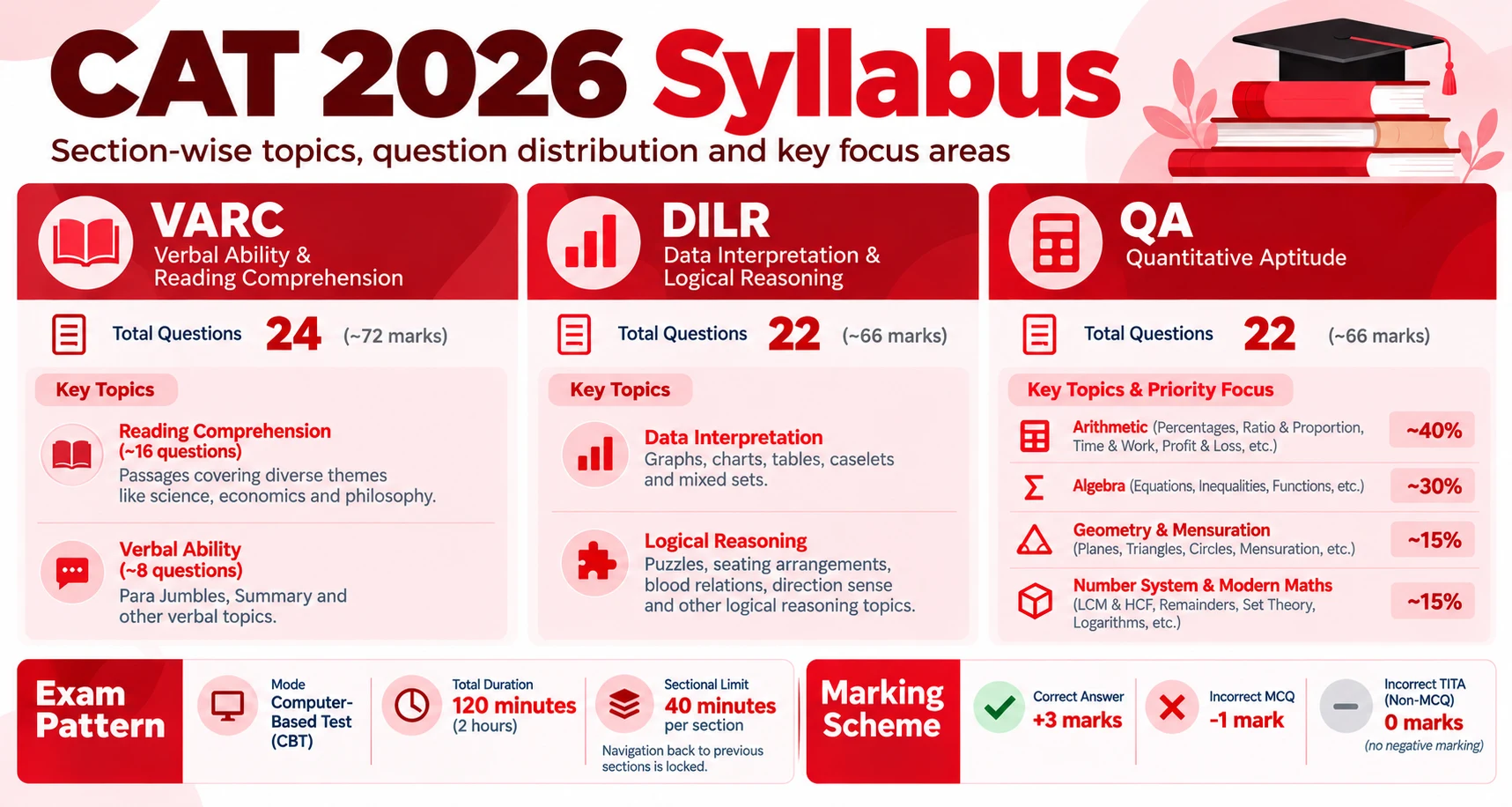
The CAT 2026 syllabus is divided into three core sections: Verbal Ability & Reading Comprehension (VARC), Data Interpretation & Logical Reasoning (DILR), and Quantitative Aptitude (QA). The exam features 68 questions totaling 204 marks across a 120-minute duration. IIM Indore has not issued an official topic-by-topic syllabus for CAT exam 2026, the CAT 2026 syllabus outline below is derived by analysing the last 10 years paper analysis by test-prep experts.
Official CAT 2026 notification out and the exam scheduled for November 29, 2026. The experts are expecting the test structure to mirror CAT 2025.
CAT Syllabus 2026 PDF: Download Complete Syllabus
There is no official CAT 2026 syllabus PDF to download. IIM Indore has published only one document for this cycle: the CAT 2026 Information Bulletin. It covers eligibility, fees, dates, reservation and exam-day rules. It does not carry a syllabus section, a topic table, or anything a candidate could genuinely call a syllabus PDF.
Coaching sites circulate their own "CAT syllabus PDF"
Several test-prep platforms publish a document titled "CAT syllabus PDF," compiled from past papers and their own analysis. That is the platform's own summary, not an IIM Indore release. It treats none of those PDFs as an official document, and does not link to one here.
The genuine official document for CAT 2026 is the Information Bulletin itself, published on iimcat.ac.in. It answers eligibility, fee and date questions directly. It does not answer syllabus questions. No amount of searching will turn up an IIM Indore syllabus PDF that does.
CAT Syllabus 2026: Highlights
CAT 2026 tests three sections in a fixed order. They are Verbal Ability and Reading Comprehension (VARC), Data Interpretation and Logical Reasoning (DILR), and Quantitative Ability (QA). IIM Indore confirms this structure in its own CAT 2026 Information Bulletin. The Bulletin also confirms the 40-minute lock per section and the no-switching rule. It confirms nothing below that level.
No official CAT syllabus exists for 2026
IIM Indore has never published a topic-by-topic CAT syllabus. The CAT 2026 Information Bulletin and Press Release name only the three sections and their order. Every topic list here, including the ones further down, is a pattern drawn from recent CAT papers, not an IIM Indore document.
3
Sections tested
VARC, DILR, QA, fixed order. IIM Indore official, CAT 2026
40 min
Time per section
Fixed, no switching between sections. IIM Indore official
0
Official topic lists published
No syllabus PDF issued by IIM Indore for CAT 2026
It covers the topic pattern that VARC, DILR and QA questions have carried across CAT 2022 through CAT 2025. IIM Indore does not release the actual CAT question paper. This pattern is reconstructed and cross-checked from recent papers instead. Read every topic list below as a study guide built from pattern, not a document you can hold IIM Indore to. For the full CAT 2026 exam calendar, eligibility and fee, see the CAT 2026 overview page.
CAT 2026 VARC Syllabus: Topics and Weightage
Verbal Ability and Reading Comprehension, VARC, is the first of CAT's three sections. It runs on its own fixed 40-minute clock, confirmed in IIM Indore's CAT 2026 Information Bulletin. No official topic list sits under that section name. What follows is the pattern across CAT 2022 through CAT 2025 papers. IIM Indore does not release the actual paper, so test-prep sources reconstructed and cross-checked this pattern themselves. It is a pattern, not an IIM Indore document.
Reading comprehension
Passages on varied subjects, not fixed to one theme, run across recent CAT papers. Questions test inference and the author's stance as often as direct recall.
Para-jumbles and paragraph completion
Rearranging jumbled sentences into a coherent paragraph, or picking the sentence that completes one, recurs across recent cycles.
Sentence-based critical reasoning
Short reasoning questions built around a single sentence or a short argument, distinct from the longer reading-comprehension passages.
Vocabulary (fill in the blanks)
Context-based word choice inside a sentence, testing usage over plain definition recall.
Verbal reasoning
Logic embedded in verbal form rather than pure comprehension, a recurring but smaller slice of the section.
No official weightage exists for any of these topics, and it will not assign one. Reading comprehension has appeared in every recent cycle's VARC section alongside the other four topics above. IIM Indore does not state how many questions each topic draws in any single sitting. Coaching sources estimate this differently. Their numbers disagree closely enough that stating one fixed number here would be false precision, not a fact.
CAT 2026 DILR Syllabus: Topics and Weightage
Data Interpretation and Logical Reasoning, DILR, is CAT's second section. It is also locked to its own 40 minutes with no switching, per IIM Indore's CAT 2026 Information Bulletin. DILR is the one section whose question count has actually moved between recent cycles. That shift is itself evidence that nothing below the section-name level is fixed by rule.
Data Interpretation
Bar graphs, line graphs, pie charts, tables, caselets and mixed-graph sets recur across recent CAT papers.
Seating arrangements
Linear and circular arrangement puzzles, a recurring Logical Reasoning format.
Venn diagrams and set-based puzzles
Questions built on overlapping sets and their logical relationships.
Constraint and matching puzzles
Puzzles where a set of conditions must all hold at once to fix an arrangement or a match.
Games, tournaments and scheduling
Logic sets built around a tournament structure, a schedule, or a sequence of rounds.
Truth-lie problems
Statements where some speakers tell the truth and others lie, and the question asks which is which.
CAT 2022 and CAT 2023 carried 20 DILR questions against 24 in VARC. CAT 2024 and CAT 2025 moved DILR up to 22, without changing VARC. That two-question shift is the clearest evidence available that CAT's internal balance is not fixed cycle to cycle. IIM Indore has never stated a reason for it anywhere. The full previous-year comparison sits later here.
CAT 2026 Quantitative Aptitude Syllabus: Topics and Weightage
Quantitative Ability, QA, is CAT's third and final section. It is also locked to a fixed 40 minutes with no switching, confirmed in IIM Indore's CAT 2026 Information Bulletin. As with VARC and DILR, no official topic list exists under this section name either.
Arithmetic
Ratios and proportions, percentages, averages, time and work, speed and distance, simple and compound interest, mixtures and alligations.
Algebra
Linear and quadratic equations, polynomials, inequalities, logarithms, and functions.
Geometry
Lines and angles, triangles, circles, coordinate geometry, and mensuration.
Number system and modern math
Number properties, permutations and combinations, probability, and sequences and series.
QA has held at 22 questions across CAT 2022 through CAT 2025, per the recent-cycle pattern. It is the one section IIM Indore has not resized while DILR moved. That stability is a pattern, not a rule IIM Indore has committed to for CAT 2026.
CAT 2026 Syllabus: Section-Wise Important Topics
Knowing the CAT 2026 topic list is one thing. Knowing where to spend a fixed 40 minutes inside each section is another. The detail below goes one layer past the plain topic lists above. It is still built from the same recent-cycle pattern, not an IIM Indore document.
Recent CAT papers mix reading comprehension passages on varied subjects with standalone para-jumble, paragraph-completion, critical-reasoning and vocabulary questions. This mix follows the pattern above. IIM Indore has not published how many questions each format carries inside VARC's 40 minutes. Treat the topic list as a study checklist, not a fixed points-per-topic table. Inference-based questions recur across this section's pattern. Reading a full passage before answering tends to help more on these than skimming for keywords does.
None of the three tabs above states a question-per-topic count. IIM Indore has not published one for any CAT cycle, 2026 included. Where a coaching source states one, treat it as that source's own estimate, cross-checked or not. Never treat it as a CAT 2026 fact.
CAT 2026 Exam Pattern and Marking Scheme
CAT 2026 runs 120 minutes total, split into three fixed 40-minute sections in the order VARC, DILR, QA. There is no switching between sections once the clock starts on one. IIM Indore confirms this directly in its CAT 2026 Information Bulletin and Press Release. It is the only exam-pattern detail it repeats from that document.
The recent-cycle marking pattern awards +3 for a correct MCQ, -1 for an incorrect one, and 0 for an unattempted question. Non-MCQ, or TITA, questions carry no negative marking at all. IIM Indore has not stated a marking scheme for CAT 2026 in either document. Hold this as the pattern every recent cycle has used, not a confirmed 2026 rule.
For the full section-wise timing table, the MCQ-versus-TITA split and how CAT's scaled score works, see the CAT 2026 exam pattern page. Its job is the topic list. That page's job is the timing and marks mechanics.
CAT Syllabus 2026: Previous Year Topic Trends
CAT's section-level topic mix is not static. The clearest proof is the question count each section has carried across recent cycles. Total questions moved from 66 in CAT 2022 and CAT 2023 to 68 in CAT 2024 and CAT 2025. Coaching platforms have tracked this pattern across those cycles. That shift is itself proof the count is not fixed by rule.
66 total questions. VARC 24, DILR 20, QA 22, per the recent-cycle pattern tracked across coaching sources.
DILR is the section that moved, from 20 to 22 questions, while VARC and QA held steady at 24 and 22. IIM Indore has not stated a reason for that shift in either its Information Bulletin or Press Release. That shift is visible only by comparing recent cycles against each other. The 2024-25 pattern, not the 2022-23 one, is the more current guide. It suggests a slightly larger DILR section in CAT 2026. Neither is an IIM Indore-confirmed figure for CAT 2026 itself, and it will not present it as one.
How to Prepare for CAT 2026 as per the Syllabus
CAT 2026 has one confirmed structural fact: three sections, VARC then DILR then QA, each locked to its own 40 minutes with no switching. This fact should drive most of a candidate's practice plan. IIM Indore's own CAT 2026 Information Bulletin confirms that single rule. It rules out a study habit many candidates default to. That habit is solving whichever section they like first and returning to a weak one later. CAT 2026 will not allow that inside the exam hall. Practising in a fixed 40-minute, no-switch block matters more here than it does for an exam that lets candidates choose their own order.
First pass
Learn the topic pattern section by section
Work through the VARC, DILR and QA topic lists above once each, without timing. Find which topics inside each 40-minute block are unfamiliar.
Second pass
Time each section separately
Practise VARC, DILR and QA as three separate 40-minute blocks, matching CAT 2026's fixed structure, rather than one untimed mixed set.
Third pass
Full-length, no-switch mocks
Sit a complete three-section mock in the fixed VARC-DILR-QA order with no switching allowed. This is the same constraint CAT 2026 itself enforces.
Final stretch
Review against recent papers, not invented lists
Use recent CAT papers to check the topic pattern against real recent questions, not a summarised list alone. These papers are reconstructed from candidate recollection, since IIM Indore does not release the official paper.
TITA questions carry no negative marking under the recent-cycle pattern. A candidate unsure of an MCQ answer has more to lose from a wrong guess than from a wrong TITA guess. This asymmetry is a confirmed pattern, not an official 2026 rule. It is worth building into mock-test decisions now, rather than discovering it on exam day. For real past questions to practise this against, see the CAT previous year question paper page.
Commonly asked questions
Answers to what readers ask most often.
Q: Does CAT have an official syllabus?
No, IIM Indore has never published an official, topic-by-topic CAT syllabus. The CAT 2026 Information Bulletin and Press Release name only the three sections, VARC, DILR and QA. They also name the fixed order. Everything below that level on it is a pattern drawn from recent CAT papers. It is not an IIM Indore document. Data Sources: CAT 2026 Information Bulletin and Press Release (iimcat.ac.in); confirmed absence of a syllabus after a full read of both documents.
Q: What are the three sections in CAT 2026?
CAT 2026 has three sections, VARC, DILR and QA, tested in that fixed order. IIM Indore confirms this directly. It also confirms the 40-minute lock on each section and the rule against switching between them. No fourth section exists. Data Sources: CAT 2026 Information Bulletin and Press Release (iimcat.ac.in).
Q: Is there an official CAT 2026 syllabus PDF to download?
No, IIM Indore has not issued a CAT 2026 syllabus PDF. Its only published document for this cycle, the Information Bulletin, covers eligibility, fees and dates, not topics. PDFs titled "CAT syllabus" circulating on coaching sites are those platforms' own compilations. They are not an IIM Indore release. Data Sources: CAT 2026 Information Bulletin (iimcat.ac.in); no separate syllabus PDF published on iimcat.ac.in as of 14 September 2026.
Q: What topics are commonly tested in CAT VARC?
Reading comprehension, para-jumbles, sentence-based critical reasoning, vocabulary and verbal reasoning make up VARC's recent pattern. This list comes from cross-checking recent CAT papers, not from an IIM Indore document. VARC's topic breakdown is not officially published. No official weightage exists among these topics either. Data Sources: Not officially published as of 14 September 2026; topic pattern based on recent CAT papers, cross-checked by test-prep sources.